
In the competitive landscape of the Phoenix real estate market, deciding whether to make your residential investment property pet-friendly is a significant operational crossroad. With a massive segment of the renting population looking for homes that welcome their animals, opening your doors to pets can be an incredibly effective strategy to maximize occupancy. However, allowing animals inside an investment property introduces distinct physical risks, neighborhood liabilities, and complex legal compliance guidelines.
Navigating this framework successfully requires high-level property oversight, strict structural guardrails, and total alignment with state statutes. This guide provides a balanced, real-world analysis of the financial benefits, physical risks, Arizona legal requirements, and management best practices for operating a pet-friendly rental property in the Phoenix Valley.
Here’s what you need to know before you allow paws on your property.
What Are the Financial and Strategic Perks of Managing Pet-Friendly Rentals in Phoenix?
Offering a pet-friendly rental property substantially expands your target tenant demographic, drives faster leasing velocity, and unlocks additional monthly revenue streams through pet rent or specialized fees. Because pet owners frequently face housing placement hurdles, they demonstrate significantly higher retention rates, reducing the financial impact of tenant turnovers. This strategic positioning keeps your investment consistently occupied and optimized for long-term cash flow.
A primary operational driver behind allowing pets is the immediate expansion of your prospective tenant pool. Data shows that over 70% of households nationwide own at least one pet, a trend heavily reflected across premium Valley submarkets like Scottsdale, Tempe, Mesa, and Gilbert. When landlords enforce absolute "no pets" bans, they immediately exclude a massive portion of qualified applicants, which inadvertently extends their vacancy windows.
Across the residential rental market, an unoptimized vacancy cycle can easily drag on for an average of 60 days, resulting in an unrecoverable vacancy loss of roughly $4,000 for a self-managed landlord. Introducing a flexible pet policy drastically cuts down this marketing timeline.
Furthermore, pet-friendly properties can command highly competitive monthly rent premiums. Landlords can structure clear, additional revenue streams to offset asset wear, including a reasonable monthly pet rent or a one-time non-refundable pet fee. Because finding high-quality, pet-friendly single-family homes is notoriously challenging, placed tenants are far more likely to renew their leases, protecting owners from the compounding costs of annual tenant turn cycles.
What Pitfalls and Property Damage Risks Should Landlords Prepare For?
The primary pitfalls of a pet-friendly rental policy include accelerated wear and tear on flooring, interior scratching, localized desert landscaping damage, and potential homeowners association (HOA) noise complaints. Landlords must mitigate these risks by enforcing comprehensive move-in inspections, structural material upgrades, and clear behavioral boundaries. Implementing professional asset oversight safeguards your property without sacrificing your rental premiums.
Allowing animals requires a realistic look at potential property degradation. In suburban communities throughout Goodyear, Peoria, Surprise, and Chandler, common pet-related damage includes scratched baseboards, ruined window blinds, soiled carpeting, and dug-up desert irrigation lines.
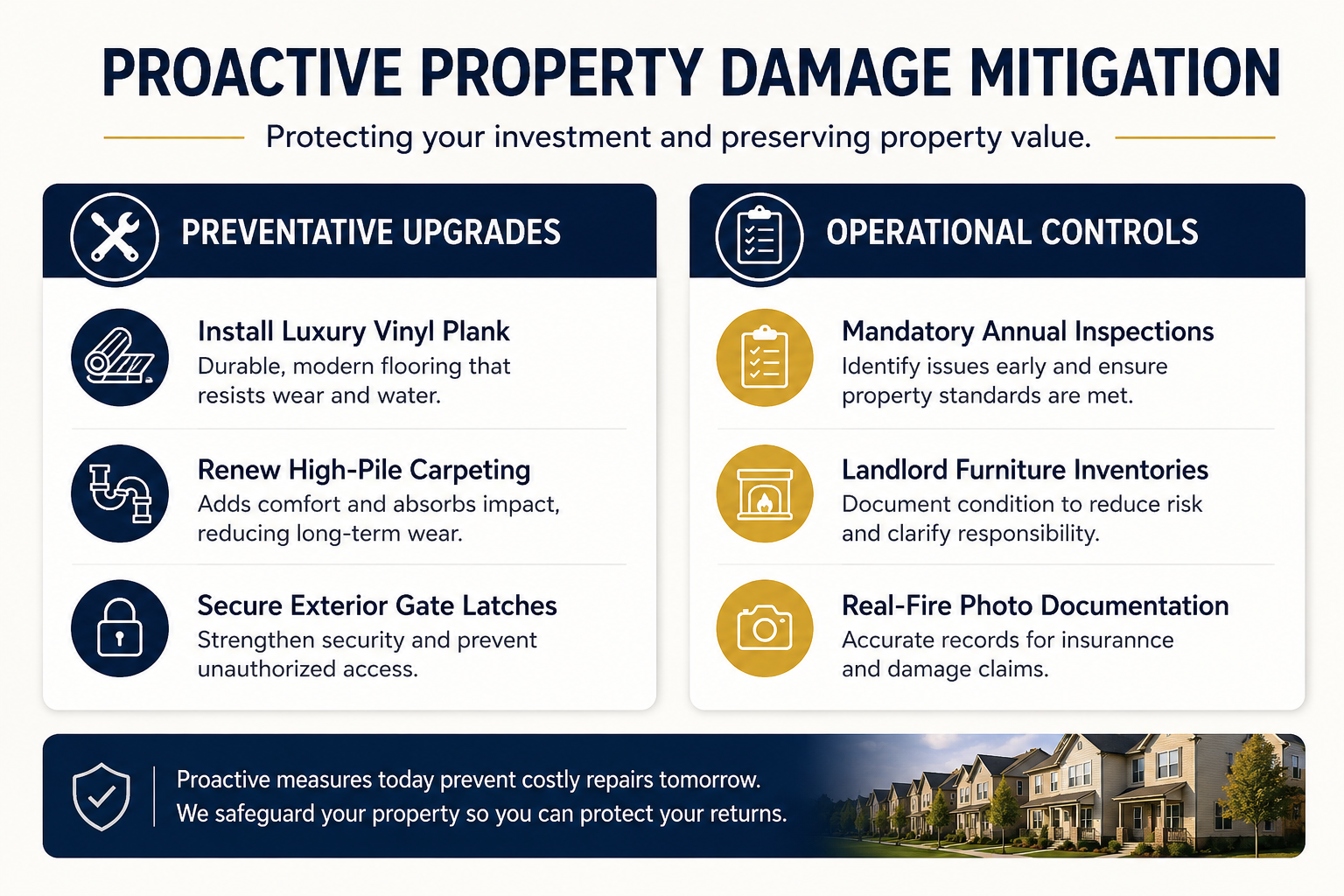
Beyond physical damage, noise disturbances like continuous dog barking or loose animals can quickly trigger formal HOA violation notices in master-planned subdivisions across Queen Creek, San Tan Valley, and Litchfield Park. To insulate property owners from financial liabilities stemming from these community disruptions, professional property management workflows deploy a clear compliance enforcement model:
Immediate Processing: Any municipal or HOA violation notice received is logged instantly into the management system.
Tenant Notification: The resident is issued a formal warning requiring immediate correction of the behavioral issue or pet nuisance.
Initial Fine Settlement: To prevent escalating legal interest or operational penalties from damaging the owner's record, the brokerage coordinates the initial fine payment.
Tenant Chargeback: The exact cost of the violation is charged directly back to the tenant's ledger and collected during the following monthly payment cycle, keeping the investor's balance sheet entirely whole.
How Does Arizona Law Regulate Pet Deposits and Fees for Rental Properties?
Arizona landlord-tenant law, governed strictly under Title 33 of the Arizona Revised Statutes (A.R.S.), dictates that the total of all refundable security deposits and prepayments cannot exceed an amount equal to 1.5 times the monthly rent. Within this mandatory statutory ceiling, property owners can legally collect a dedicated refundable pet deposit, charge non-refundable pet fees, or apply monthly pet rent. Maintaining absolute compliance with these financial limitations prevents severe statutory penalties.
Navigating Security Deposit Caps Under A.R.S. § 33-1321
When structuring a pet-friendly leasing framework, self-managing landlords often make the mistake of charging a standard security deposit and adding a hefty pet deposit on top, inadvertently exceeding the legal limit set by A.R.S. § 33-1321. The law states that a landlord cannot demand or receive a total refundable security deposit or prepayment that exceeds 1.5 times the monthly rent.
For example, on a property renting for $2,000 per month, the maximum combined refundable deposit allowed is $3,000. To protect your investment while staying legally compliant, a common best practice is to collect a reasonable refundable pet deposit, such as $250 per pet, while ensuring the absolute sum of all deposits remains safely under the 1.5-month statutory cap.
Processing Post-Lease Dispositions and Deductions
Upon the termination of a tenancy, a thorough move-out inspection is conducted to compare the property's condition directly against the initial move-in report. If a pet has caused damage that goes beyond normal wear and tear, such as deep carpet staining or structural scratching, the exact costs for professional remediation are itemized and deducted from the accumulated security deposits. All deductions must be processed and delivered to the past resident in strict accordance with Arizona's mandatory statutory timelines to avoid civil exposure.
How Should an Investor Structure an Effective Rental Property Pet Policy?
An effective rental pet policy must explicitly define clear limits on animal quantities, enforce independent pet screening protocols, and integrate a comprehensive pet addendum directly into the lease agreement. Restricting occupancies to a maximum of two pets naturally minimizes property wear while keeping the asset aligned with premium leasing performance metrics. This programmatic approach ensures total operational consistency across your entire real estate portfolio.
To achieve maximum asset performance, your pet parameters can be tied directly to a comprehensive 30-Day Rental Guarantee structure. Under this framework, to ensure a vacant property is successfully leased within 30 days or less, the home must be vacant, professionally cleaned, priced to market recommendations, and fully open to a maximum of two pets. Restricting the policy to two animals strikes an ideal balance, capturing the largest segment of the local renter demographic while keeping physical wear well within manageable operational limits.
Implementing Rigorous Vetting Standards
Before approving any animal for placement, prospective residents must navigate a multi-layered verification framework. This is executed concurrently with our primary tenant screening standards, which mandate a baseline household credit score of 620 and a verifiable pre-tax income equal to at least 2.5 times the monthly rent. The dedicated pet screening lifecycle includes:
Historical Landlord References: Direct verification with previous property owners to confirm the animal has zero history of structural destruction, aggressive behavior, or unmanaged noise disruptions.
Comprehensive Health Records: Requiring certified veterinary documentation detailing up-to-date vaccinations and active local licensing records.
Visual Photographic Logs: Capturing clear, real-time digital photographs of the specific animal to maintain an accurate identity profile throughout the tenancy.
What Legal Guidelines Govern Assistance Animals and Emotional Support Animals (ESAs)?
Assistance animals and Emotional Support Animals (ESAs) are not classified as pets under federal or state law; instead, they are recognized as essential accommodations for individuals with disabilities under the Fair Housing Act (FHA). Consequently, property owners are strictly prohibited from applying standard pet rent, non-refundable fees, refundable pet deposits, or breed restrictions to these animals. Failing to honor these federal protections can expose an investor to costly federal discrimination lawsuits.
Navigating the distinct legal boundaries between standard household pets and verified assistance animals is a critical operational requirement for modern real estate investors. Federal regulations strictly protect individuals who rely on service animals or emotional support animals to assist with physical or mental health conditions.
When an applicant or existing resident submits a formal request for an accommodation involving an assistance animal, the landlord is legally required to waive all pet-related financial criteria. Property managers verify valid documentation from a licensed healthcare professional to confirm the connection between the individual's disability and the assistance the animal provides.
While landlords cannot collect a pet deposit or pet rent for these animals, the resident remains fully liable for any physical damage the animal causes to the home. The cost of repairs can still be deducted from the standard property security deposit during the move-out accounting lifecycle.
What Is the Total Financial Value of Flat-Rate Professional Oversight?
Transitioning a rental property into a highly profitable, hands-off investment requires moving away from traditional, variable percentage-based management fees that take a bite out of your rental premiums. Utilizing a transparent, flat-rate pricing model provides full-service operational care for a predictable cost of $99 per month per occupied unit. This straightforward approach provides total financial transparency and protects your long-term capital.
As outlined in our transparent property management pricing, an optimized management system completely removes hidden administrative upcharges, setup fees, or digital lease premiums. The upfront onboarding and digital marketing phase requires zero out-of-pocket costs from the property owner. A flat $800 tenant placement fee is deducted only after a qualified resident is successfully secured and their first month's rent is collected.
This placement fee covers high-end professional photography, multi-channel web syndication across 32+ digital portals, and full lease execution. When a quality resident decides to extend their stay after their initial term, the lease renewal fee is reduced to a flat $400, rewarding long-term structural stability.
Frequently Asked Questions
Can I legally restrict specific animal breeds from my Phoenix rental property?
For standard household pets, landlords have the full legal right to implement specific breed, weight, and quantity restrictions based on their personal preferences or insurance policy limitations. However, under the Fair Housing Act, standard breed and weight restrictions cannot be applied to verified service animals or emotional support animals (ESAs).
What is the maximum refundable pet deposit I can charge under Arizona law?
Arizona law does not set a standalone limit on pet deposits, but A.R.S. § 33-1321 mandates that the total of all refundable deposits combined (including standard security, cleaning, and pet deposits) cannot exceed 1.5 times the monthly rent. For example, a property manager can easily structure a $250 refundable deposit per pet, provided the total deposit bundle stays safely within that 1.5-month statutory ceiling.
Are monthly property management fees charged while my rental sits vacant?
No. High-integrity property management frameworks tie their business compensation directly to the actual performance of your underlying asset. The flat-rate $99 monthly property management fee will not occur while the property is sitting vacant on the market.
What happens if a tenant brings in an unauthorized pet during their tenancy?
If an unauthorized animal is discovered on the premises, it constitutes a clear lease violation. The property management team will immediately issue a formal non-compliance notice requiring the resident to either remove the animal or officially add it to the lease under our approved screening parameters, including paying any required pet deposits or fees.
Protect and Optimize Your Real Estate Portfolio
Implementing a pet-friendly policy is a highly effective way to maximize your rental income, accelerate leasing speeds, and reduce tenant turnover across the Valley. However, successfully managing the underlying risks requires constant vigilance, bulletproof documentation, and absolute adherence to state and federal housing laws. Partnering with a licensed real estate firm turns these daily operational challenges into a truly passive, profitable investment.
The dedicated professionals at Real Estate Brokers of Arizona use over a decade of local market mastery to manage hundreds of residential rentals across Phoenix, Mesa, Gilbert, Chandler, Scottsdale, and surrounding municipalities. We stand behind our results with performance-backed commitments, including a 30-Day Rental Guarantee, a Reachability Guarantee, and a risk-free Happiness Guarantee that lets you cancel your agreement without penalty at any time with a simple 30-day written notice.
Contact Real Estate Brokers of Arizona today or call 480-916-8900 to speak with a property expert and discover how our flat-rate services can streamline your investment portfolio.
Additional Resources: